15 Corporate Event Entertainment Ideas That Actually Impress
The best corporate event entertainment ideas in 2026 share one trait: they give guests something to take home that isn't a tote bag. Branded swag gets left in a hotel room. A permanent mark, a real skill, or a story that follows them to Monday's standup — that's what turns a calendar block into an event people remember.
This list covers 15 ideas that move past the open bar and the DJ. We've run one of these (a tattoo popup) at events for Playboy, Red Bull, and HarperCollins, so that section gets more depth. The other 14 are organized by what they actually solve for a planner: energy, content, team bonding, and the moment guests talk about on the ride home.
Skip the bowling alley. Read this first.
Contents
- Cocktail Competitions With a Real Judge
- Escape Room, Built On-Site
- Tattoo Popup: The Only Thing That Lasts
- Live Art That the Brand Owns
- VR Stations With a Use Case
- Celebrity Speaker, Sized Right
- Improv Troupe, Briefed on the Brand
- Mixology Class With a Working Bartender
- Silent Disco With Three DJs
- Live Band Sized to the Room
- Cooking Challenge With a Real Chef
- Charity Build, Done in One Night
- Drone Show, Outside the Venue
- Casino Night, Run for Real
- The Tattoo Popup, Reconsidered
- What to Skip in 2026
- How to Pick the Right Idea
1. Cocktail Competitions With a Real Judge
Pick a featured spirit, hand each team a basket of ingredients, and give them 8 minutes to build a cocktail. A working bartender judges on balance, creativity, and presentation. The format works because it has stakes, a clock, and a clear winner — three things most icebreakers lack.
Pair it with a non-alcoholic version so the people not drinking stay in the game. Budget around $35-50 per person for ingredients and glassware. Run it in groups of 6-8 so nobody is watching from a chair.
Real-world example: Diageo's annual brand summit runs a cocktail throwdown every year. Teams of six get a black-basket of Johnnie Walker, Don Julio, and Bulleit ingredients and build a serve against a head bartender from one of their restaurants. They've kept it for four years straight — the format works because the judging is real and the standard is high.
2. Escape Room, Built On-Site
Most escape rooms require a bus ride and an operator you don't control. The better move: hire an experience designer to build a custom room in your venue's empty meeting space. Theme it to your company's year — a product launch, a fictional crisis, a heist of the CEO's office.
A 45-minute room holds 8-12 people. Throughput matters more than difficulty. Build 2-3 rooms and rotate teams so the line stays short. Budget runs $4,000-12,000 depending on build complexity.
Real-world example: Salesforce took over Pier 27 in San Francisco for their annual sales kickoff and had three custom escape rooms built — one themed to a product launch, one to a fictional data breach, one to a heist of Marc Benioff's office. 4,000 attendees cycled through over two nights. The escape rooms became the most-quoted session of the entire conference.
3. Tattoo Popup: The Only Thing That Lasts
Most entertainment is gone by morning. The tattoo popup is the one activation that survives the event.
Here's how a corporate tattoo popup runs:
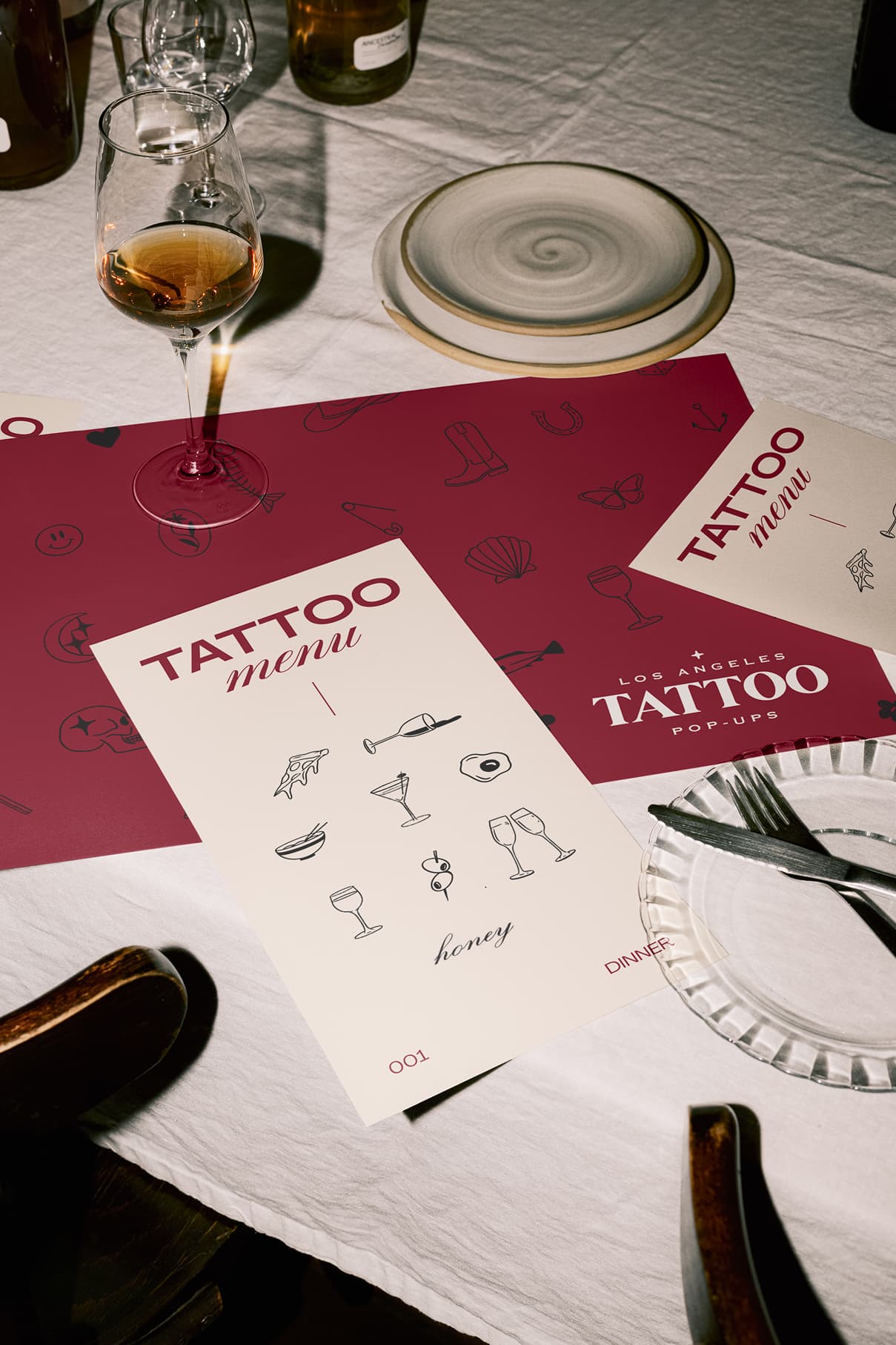
Branded flash sheet. We design the flash around your event — your logo reimagined, your campaign art adapted, your city rendered in fine line. Guests pick from a curated menu of 8-12 designs sized to fit forearms, ribs, ankles, and the inside of the bicep. Nothing generic. Nothing templated.
Safety and licensing, handled. Every artist on the crew is licensed in the event's state, bloodborne pathogen certified, and insured for $2M+ general liability. We carry single-use needles, autoclaved equipment, and FDA-approved pigment. The venue signs off before we set up. The permits are pulled before the trucks roll. You never see any of this. That's the point.
Throughput. A 2-artist crew produces 3-5 tattoos per hour, roughly 3× the industry average. We scale the crew to your guest count: 200 guests over 4 hours means a 4-artist team with 2 assistants, a host on the line, and a coordinator running the floor. The line moves. The energy stays.
What guests leave with. A real tattoo, healed and aftercared, designed specifically for the night they got it. First-timers make up 60-70% of our guests. The experience converts people who never thought about getting one into people who walked out wearing one.
Who we've run it for. Playboy (the crew dressed in Honey Birdette lingerie for a brand activation — the photos ran for a year). Red Bull (80 temporary tattoos over 12 hours at a midsummer festival). HarperCollins (a launch event where authors and readers tattooed side by side). Each one ran without a hitch because the activation is built to run itself.
This is the idea on this list with the longest half-life. The cocktails are gone by morning. The escape room is a memory by Tuesday. The tattoo is on someone's arm in 2029 when they're pitching a client.
We run these for brands every week. See how the activation works for marketing teams →
4. Live Art That the Brand Owns
Hire an artist to build a mural live during the event. The piece evolves over 3-4 hours. By the end of the night, the mural is photographed, signed, and shipped to your headquarters or auctioned for charity.
The format works because it produces content. Every 30 minutes the mural looks different, which means guests keep returning to check on it. The finished work is a permanent asset — usable for press, for office walls, for the company's Instagram for the next year.
Budget: $3,000-15,000 depending on artist and scale. Confirm the venue allows paint and prep the wall surface in advance.
Real-world example: Reddit's annual "Upvote" employee summit in 2024 commissioned a 12-foot mural that was built live over the closing-night party. The finished piece shipped to Reddit's San Francisco HQ and now hangs in the all-hands auditorium. Every internal event gets photographed in front of it.
5. VR Stations With a Use Case
VR demos fall flat when they're random. Pick a station tied to a real moment: a product prototype walkthrough for hardware companies, a venue flythrough for real estate launches, a training simulation for enterprise software.
Run 2-3 stations with headsets, a host who runs each experience, and a queue managed by a sign-up sheet. The use case is what makes it sticky. A random rollercoaster demo gets walked past. A tour of the factory the company just built gets a crowd.
Real-world example: Trimble ran a VR walkthrough of a not-yet-built offshore wind farm at their annual innovation summit. Engineers who had worked on the project for two years walked through the structure before a single piece of steel was cut. The demo ran for the full 6-hour window with a 40-minute wait by 9pm.
6. Celebrity Speaker, Sized Right
A-list speakers run $50,000-200,000 and pull a crowd for 40 minutes. Mid-tier voices (retired athletes, founders, journalists, chefs) run $10,000-25,000 and often deliver more substance because they're closer to the working world.
Skip the motivational speaker. Book someone who has built, sold, lost, or written about a real thing. Pair the talk with a 20-minute Q&A moderated by your CEO. The format earns the cost.
Real-world example: Mailchimp booked chef and author Kwame Onwuachi for their 2024 company offsite. He cooked three dishes live while telling the story of rebuilding his restaurant after a closure. The 90-minute format cost $40,000 and became the highest-rated session in the company's internal post-event survey.
7. Improv Troupe, Briefed on the Brand
A 30-minute improv set, themed to the company, performed by a 4-person professional troupe. The trick: brief them 2 weeks in advance with real material — customer reviews, internal Slack screenshots (cleared, obviously), the CEO's last earnings call.
The set lands because it's specific. Generic improv feels like a college orientation. Improv built on the company's actual absurdity feels like the truest thing at the event.
Budget: $2,500-6,000 for a quality regional troupe. Skip national names — the cost gap isn't worth the gain.
Real-world example: HubSpot's annual "INBOUND" partner summit in 2023 had a Boston-based improv troupe (Improv Asylum) open the partner kickoff with a 25-minute set built entirely from real customer support tickets. The clips hit 200,000 views on LinkedIn within a week.
8. Mixology Class With a Working Bartender
Not a cocktail competition — a class. A working bartender teaches 12-15 guests to build 3 drinks from scratch, with history, technique, and tasting built in. Runs 75-90 minutes.
The format works because it's a skill guests take home. Three weeks later, someone makes a Negroni at a dinner party and tells the story about the company that taught them. That's reach.
Pair it with a recipe card designed in your brand system. Send it home with each guest.
Real-world example: Tanqueray ran a 12-station mixology lab at the Tales of the Cocktail trade show in New Orleans. Each station was led by a bartender from a different Tanqueray-affiliated bar, and guests rotated through every 20 minutes. The branded recipe cards (designed in Tanqueray's visual system) ended up mailed to 4,000 attendees the following week.
9. Silent Disco With Three DJs
Three channels, three DJs, three genres. Guests pick a color on the headset. The room splits into tribes and dances to three different sets at once.
Why it works at corporate events: no noise complaints, no venue cap on volume, no awkward silence when the open bar opens. The visual is also content — a room full of people dancing to different songs in glowing headphones is a photograph that explains itself.
Budget: $8-15 per headset for 150-300 units. Book through a regional silent disco company; the logistics are real.
Real-world example: WeWork's annual member summit ran a silent disco on the rooftop of Pier 17 in Manhattan in 2023 — three channels, three DJs (a hip-hop set, an indie set, and a house set), 800 headsets. The noise complaint from neighboring piers was zero. The branded recap video opened with a 12-second clip of the disco in action.
10. Live Band Sized to the Room
Skip the DJ for events under 150 guests. A 6-8 piece band (vocals, keys, bass, drums, guitar, horn) raises the perceived production value by 10× over a DJ at the same cost, because the energy is acoustic and visual at once.
Match the genre to the crowd. A 90s cover band works for a company in its 30s. A jazz trio works for a wine reception. A Latin band works if the audience is international. Test the band with a 20-minute set before signing.
Real-world example: Glossier's summer employee party at the Knockdown Center in Queens ran a 7-piece soul band for the closing two hours. The band cost $6,500 — about the same as the DJ they almost booked — and the floor stayed full until 1am.
11. Cooking Challenge With a Real Chef
A 60-minute cooking challenge, judged by a working chef, with teams of 4-6. The trick: pre-portion ingredients so setup is fast, and pick a dish that can plausibly be built in an hour (hand-rolled pasta, taco al pastor on a portable spit, sushi rolls).
The chef matters. A Michelin-trained chef turns a corporate team-building exercise into the most memorable hour of the night. Budget $4,000-10,000 for a chef and team.
Real-world example: Pinterest's annual company offsite in 2022 had chef Melissa King (Top Chef finalist) judge a 12-team dumpling competition. Each team made a regional dumpling from a different country. The winners got a private dinner at her restaurant. The format ran for a third year in a row.
12. Charity Build, Done in One Night
Pick a tangible outcome — bikes for kids, care packages for a shelter, hygiene kits for a women's shelter. Guests assemble the kits during the event. The company donates per kit built.
This is the idea on this list with the longest emotional half-life. Guests leave knowing exactly what they did. The kits ship the next morning with a card from the company. The story follows the recipients.
Budget: $25-50 per kit. Plan a recipient partner 6-8 weeks out. Confirm logistics for pickup the next day.
Real-world example: Toms built 5,000 shoe kits in one evening at their 2019 all-hands. Every employee built 15 kits, the company matched with a $75,000 donation, and the kits shipped to three LA-area shelters the following morning. The story was the most-shared internal content of the year.
13. Drone Show, Outside the Venue
A 200-drone show runs 8-12 minutes, choreographed to a soundtrack, forming logos, products, and animated figures in the sky above the venue. It's the highest-impact visual production available to a corporate event in 2026.
The constraint: regulatory approval (FAA Part 107 waivers, venue permission, no-fly zone clearance), weather backup, and a sight line cleared for 400+ feet. Plan 90 days out. Budget $30,000-75,000.
Skip if the venue is urban with no outdoor line of sight. Skip if the event is under 100 guests — the cost-per-head math breaks. For a 300+ guest outdoor event, nothing else moves the needle like a drone show.
Real-world example: Coinbase ran a 500-drone show above the Las Vegas Convention Center for their annual "State of Crypto" summit in 2024. The 12-minute show featured the Coinbase logo morphing into a Bitcoin symbol morphing into a QR code. The clip hit 12 million views across social.
14. Casino Night, Run for Real
Blackjack, roulette, poker. Croupiers in formal attire. Guests trade a $500 buy-in for chips, then play for 2 hours. Top 3 chip counts win prizes. Non-winners redeem remaining chips for a donation to a charity of the company's choice.
This format works because it removes the casino's predatory edge. Everyone starts equal. The house is a charity. The stakes are a story, not a paycheck.
Confirm venue rules on gaming simulators (most states allow them with no cash exchange). Budget $6,000-12,000 for croupiers, tables, and chips.
Real-world example: Stripe's annual partner retreat in Scottsdale closed with a casino night where the house was the Boys & Girls Club of Greater Scottsdale. All unredeemed chips converted to a corporate donation at the end of the night. The charity received $84,000. The retreat ended with no one upset about losing.
15. The Tattoo Popup, Reconsidered
Most corporate entertainment is consumed and forgotten. The escape room ends. The casino closes. The mural gets photographed and filed.
The tattoo popup is the one activation on this list that produces a permanent artifact. Six months after the event, a guest rolls up a sleeve in a meeting and someone asks where the design came from. The story starts again. That's the reach no other format produces.
If the goal is a night people remember, run a cocktail competition. If the goal is a moment people carry into their next job, run a tattoo popup.
For HR, legal, and marketing leads who need the full breakdown — insurance, throughput, waivers, brand integrations — read the complete corporate tattoo guide. For the cost numbers, see how much a tattoo popup actually costs. For the start-here overview of how live tattooing at events works, read everything you need to know about event tattooing.
Corporate event entertainment ideas vs. corporate event ideas 2026: how they differ
The phrase "corporate event entertainment ideas" usually means the activation on the floor — what guests do between the keynote and the last call. "Corporate event ideas 2026" is broader: it covers the format (offsite vs. in-office), the timing, the venue, and the budget architecture. The 15 ideas above are entertainment. The framework for picking the right one for 2026 specifically — given post-pandemic budgets, hybrid teams, and tighter ROI expectations from finance — is below.
Three forces are reshaping corporate event ideas for 2026:
- The half-life test. Finance teams are asking what an activation produces 90 days, 12 months, and 5 years after the event. Photo booths fail the test. Tattoos pass it. Every line item now gets defended against that question.
- The hybrid headcount. Distributed teams mean fewer all-hands and more regional activations. The 200-guest dinner is back. The 2,000-person conference is the exception. The formats on this list scale down better than the formats they're replacing.
- The content mandate. Marketing teams want every activation to produce shareable content. Live art, silent disco, tattoo popups, drone shows — all produce content the brand can run for a year. A magician doesn't.
Pick formats that pass all three. The tattoo popup passes all three. Most of the others pass two.
What to skip in 2026
A few formats that look good on a proposal and play poorly on the floor:
- Photo booths. The content stopped being interesting in 2019. Skip.
- Generic trivia apps. Online platforms that run a pub trivia format over the company. The execution rarely lands. If you want trivia, hire a live host and build the questions in-house.
- Magicians. Walk-around magic is a 1990s corporate default. The only exception: a headline magician doing a 30-minute stage set, which is a different production entirely.
- Caricature artists. Slow queue, dated output, no social reach.
- Aerial silk performers / fire spinners. Great for a festival. Wrong register for a B2B event. The audience will feel talked down to.
The throughline: if the activation doesn't produce content, conversation, or a takeaway, it probably isn't worth the line item.
How to pick the right idea
Three questions:
- What does the guest leave with? A skill, a story, a tattoo, a photo. If the answer is "a tote bag," keep looking.
- What does the company get? Content, press, employee bonding, sales pipeline. Match the activation to the business outcome.
- What's the half-life? Will anyone talk about this in 90 days? In 12 months? In 5 years? Only one idea on this list has a 5-year half-life.
If you can answer those three, the format picks itself.
Planning a corporate event? Read our complete corporate tattoo guide.
The tattoo popup is the only entertainment on this list that produces a permanent artifact. For event planners and brand teams evaluating it as an option, we put together the full guide — what it costs, how the crew sizes, what the flash sheet process looks like, and how to brief a venue on safety requirements.
Read the corporate tattoo guide →
Or, if you'd rather just talk it through with a planner, tell us about your event →. We send proposals within 24 hours.