Everything You Need to Know About Live Tattooing at Events
Live tattooing at events is a licensed crew setting up a professional tattoo station at your venue and tattooing real guests on the spot — permanent, temporary, or semi-permanent. A 4-person crew runs the setup like a small studio: artist, assistant, check-in host, event coordinator. Guests walk in, choose a flash design, get tattooed, and walk out with something they'll still have years later. It's the only branded activation at your event that can't be thrown away.
This post is the start-here guide. It covers what live event tattooing is, how it works day-of, the event types it fits, the difference between permanent, temporary, and semi-permanent options, safety standards, what it costs, and the first-tattoo phenomenon that makes these activations memorable. If you're researching event tattoo services, this is the page that links to everything else.
For the step-by-step day-of rundown, jump to How it works. For brand activations specifically, see our brand activation page. For weddings, see live tattooing at weddings.
Contents
- What live tattooing at events actually is
- How it works day-of
- Event types that work
- Permanent, temporary, and semi-permanent — what's the difference
- Safety and licensing
- What it costs
- The first-tattoo phenomenon
- What to read next
What live tattooing at events actually is (the start-here definition)
If you've never hired a live tattooing service before, the format can sound like a contradiction: a real tattoo studio, popped up at your venue for one night, run by a crew instead of a single artist, scaled to the guest count, and gone before sunrise. An event tattoo service brings a complete tattoo operation to your venue — hotel ballroom, brand activation, private estate, festival grounds, rooftop, or backyard wedding. The crew arrives with portable stations, single-use equipment, sterilization gear, custom flash sheets, aftercare kits, and a digital check-in system. They set up in 2 hours, run for the agreed window, and break down without leaving a trace.
Live tattooing differs from a mobile tattoo artist in 3 ways:
- Crew, not solo artist. A 4-person team handles the line, the waivers, the setup, the design curation, and the aftercare. The host doesn't manage any of it.
- Throughput built for events. A solo artist averages 1-2 tattoos per hour. A professional crew runs 3-5 tattoos per hour per artist — 3× the industry baseline.
- Designed for the room. The flash sheet, the crew attire, the aftercare packaging, and the queue system are built around your event's aesthetic, not the artist's portfolio.
That last point is the difference between an event tattoo company and someone who tattoos on the side. One produces a curated experience that fits the property. The other produces a portfolio piece that doesn't.
How it works day-of
The system runs the same way every time. Guests don't see the machinery — they see a clean station, a friendly host, a custom flash sheet, and a short wait. If you want the full step-by-step format, the how it works page covers it from the venue's perspective.
- Check-in. A check-in host greets each guest, verifies ID (18+ for permanent), screens for alcohol consumption, and confirms the waiver on a tablet. Guests who have been drinking don't get tattooed. RBS-trained staff run this step at every event with a bar.
- Design selection. Guests pick from 10-15 custom flash designs created for your event. The flash is curated in advance — your brand mark, your wedding monogram, your event iconography, or a custom aesthetic built around the theme.
- Tattoo. An artist works one guest at a time. An assistant preps the station, swaps single-use needles, handles setup between clients, and keeps the line moving. Most tattoos finish in 15-30 minutes.
- Aftercare. Guests leave with a branded aftercare kit — bandage, cleanser, moisturizer, written instructions. We follow up within 30 days for touch-ups, though the policy is rarely used.
From the host's perspective: nothing to manage. The crew handles the line, the questions, the edge cases, the breakdown.
Event types that work
Live tattooing fits a wider range of events than most people expect. The format scales from 30 guests to 5,000.
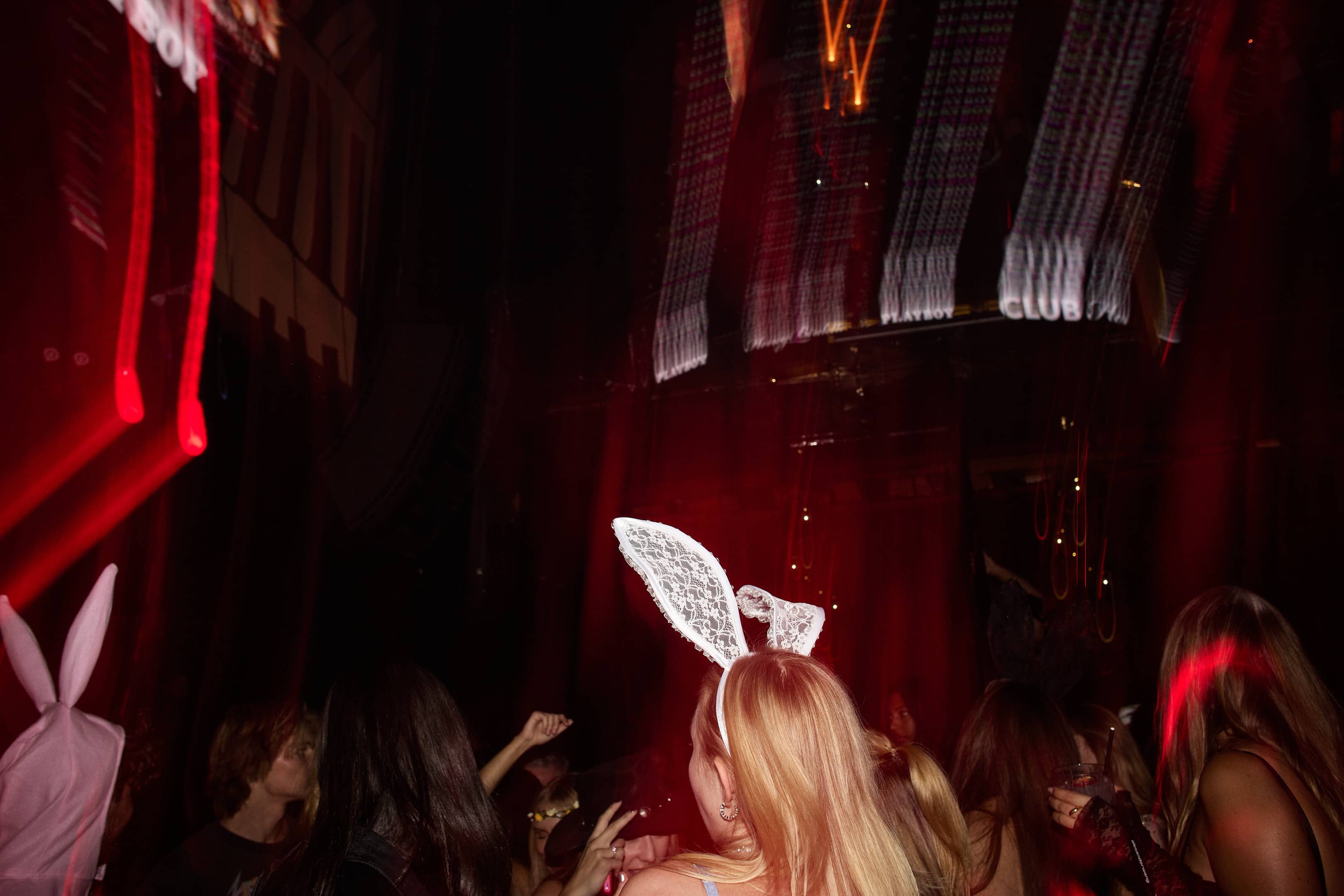
- Brand activations. The tattoo is the takeaway. Permanent placement means guests wear the brand weeks, months, years after the campaign ends. Playboy, Honey Birdette, Red Bull, and HarperCollins have used this format at product launches, seasonal activations, and editorial events. Full details on our brand activations page.
- Corporate events. Holiday parties, sales kickoffs, milestone celebrations. The activation runs 4-6 hours, guests rotate through, and the conversation lives on long after the event ends.
- Weddings. Rehearsal dinners and receptions. Couples offer matching tattoos, custom monograms, or guest-of-honor flash. Participation rates run 20-30% of attendees. See weddings for the couples-facing version.
- Hotels and hospitality. Residencies and one-night pop-ups. Curated for the property's aesthetic — designed to belong, not to compete with the lobby.
- Festivals. Multi-day, high-volume operations. Throughput scales to 250-500 tattoos per day with a 2-artist crew.
- Private parties. Birthdays, anniversaries, milestone celebrations. Compact footprint (10×10), 4-hour window, custom flash for the guest of honor.
- Destination events. International weddings, brand launches abroad, and remote retreats. Lead times stretch to 8-12 weeks to handle permits, customs, and travel.
The format adapts to almost any brief. The constraints are space (10×10 minimum, ideally near a washing station), power (20-amp circuit), and lead time (4-6 weeks minimum, longer for permit-heavy markets).
For our home market, Los Angeles event tattooing covers permits, venue logistics, and the most-booked properties in the city.
Permanent, temporary, and semi-permanent — what's the difference
Every event offers a mix. Picking the right mix depends on your audience, your brand, and the message you want to leave.
- Permanent — Real tattoo, real ink, forever — Lasts a lifetime — Best for brand activations, milestone moments, guests who opt in — 3–5 per artist per hour
- Temporary — Applied with water, sits on skin — Lasts up to 24 hours — Best for high-volume events, kids, guests who want the moment without commitment — 7–8 per artist per hour
- Semi-permanent — Jagua-based, sits in the top layer of skin — Lasts 2–4 weeks — Best for guests who want permanence without lifetime, festivals, novelty events — 5–6 per artist per hour
Permanent tattoos use real equipment, real needles, real sterilization. Arms and shoulders only at events — no hands, feet, face, or neck. 18+ only. The crew handles consent, waivers, and aftercare for every guest.
Temporary tattoos look like the real thing but wash off. The flash designs run custom, but the application takes 2-3 minutes per guest. Throughput is the highest of the three formats.
Semi-permanent tattoos use jagua, a plant-based gel that stains the skin like a temporary henna tattoo but lasts 2-4 weeks. The sheets cure before the event, which is why semi-permanent formats need a 30-day lead time. This is not henna. Henna is a different plant with different chemistry, and mixing them up is a common mistake guests make.
Most events run a combination: 60-70% permanent, 20-30% temporary, 10% semi-permanent. The mix depends on the audience. A 200-person brand activation with an open bar might run 50/50. A wedding might run 90% permanent with a few temporary options for guests who want to participate without commitment.
Safety and licensing
Safety is the first question every event planner, legal team, and venue asks. The short answer: licensed artists, single-use equipment, $2M liability insurance, and verifiable standards.
- Licensed artists only. Every artist on the crew holds a current tattoo license in the jurisdiction where the event takes place. Los Angeles requires county health department permits. New York City requires state and city credentials. Miami-Dade requires county licensing. The crew confirms credentials before every booking.
- BBP certification. Every crew member completes Bloodborne Pathogen training annually. RBS-trained check-in hosts screen for alcohol consumption at every event with a bar.
- Single-use equipment. Needles, tubes, ink caps, and barriers are single-use. They open in front of the guest and dispose in a medical waste container after.
- $2M liability insurance. Per occurrence. The COI names the venue and the client as additional insureds on request.
- Age verification. 18+ for permanent ink. No exceptions. ID checked at check-in.
- Venue compliance. Crews carry health department documentation, portable handwashing stations when required, and follow jurisdiction-specific protocols.
The full safety documentation, including venue compliance checklists, is on the Safety & Standards page. Send it to your legal team before booking.
What it costs
Most event tattoo services fall between $2,500 and $15,000. The exact number depends on 5 things:
- Crew size. 2 artists, 1 assistant, 1 coordinator is the standard 4-person setup. Larger events add artists to scale throughput.
- Hours. 4-hour minimum. Most events run 4-6 hours. Festivals run 8-12.
- City. Hub cities (LA, NYC, Miami, Las Vegas) carry standard rates. Destination events add travel, lodging, and per diem.
- Flash complexity. A custom flash sheet designed from scratch takes longer than a curated sheet from existing artwork.
- Format mix. Permanent-only events cost more than events with a temporary option, because the artist runs at lower throughput.
The proposal includes everything: artists, crew, setup, breakdown, flash design, aftercare kits, insurance, permits, and travel. No add-ons. No surprise line items.
For a detailed breakdown of what drives pricing, read How Much Does a Tattoo Popup Cost.
The first-tattoo phenomenon
Across thousands of tattoos at hundreds of events, one pattern repeats: 60-70% of guests at any activation are first-timers. Most have thought about getting a tattoo for years. Some have appointments scheduled and never show. Some have been told by friends that it hurts too much. None of them expected to get tattooed at a party.
The activation lowers the threshold. A friend is doing it next to them. The artist talks them through the design. The aftercare is handed to them with instructions. The room is safe, the lights are good, the host is friendly. They sit down, they get tattooed, and 20 minutes later they walk out with something they've wanted for a decade.
The strongest story in our archive: a 70-year-old woman at Red Bull Midsummer got her first tattoo after thinking about it for 50 years. The artist did a small line drawing on her forearm. Her friends cried. She showed it off the rest of the night. The photo ran on Red Bull's recap.
That's the territory no other event activation occupies. Photo booths create a strip. Custom merch creates a tote. Tattoos create a permanent shift in someone's relationship with their own body. The activation doesn't end when guests leave — it lives on them.
See how it works
The proposal tells you the cost, the crew, the flash design, and the timeline for your specific event. We send one within 24 hours of the first call.
- See how it works →
- Browse brand activations →
- Plan a wedding tattoo popup →
- Los Angeles event tattooing →
- Get a proposal for your event →