Live Tattooing at Weddings: Everything Couples Need to Know Before Booking
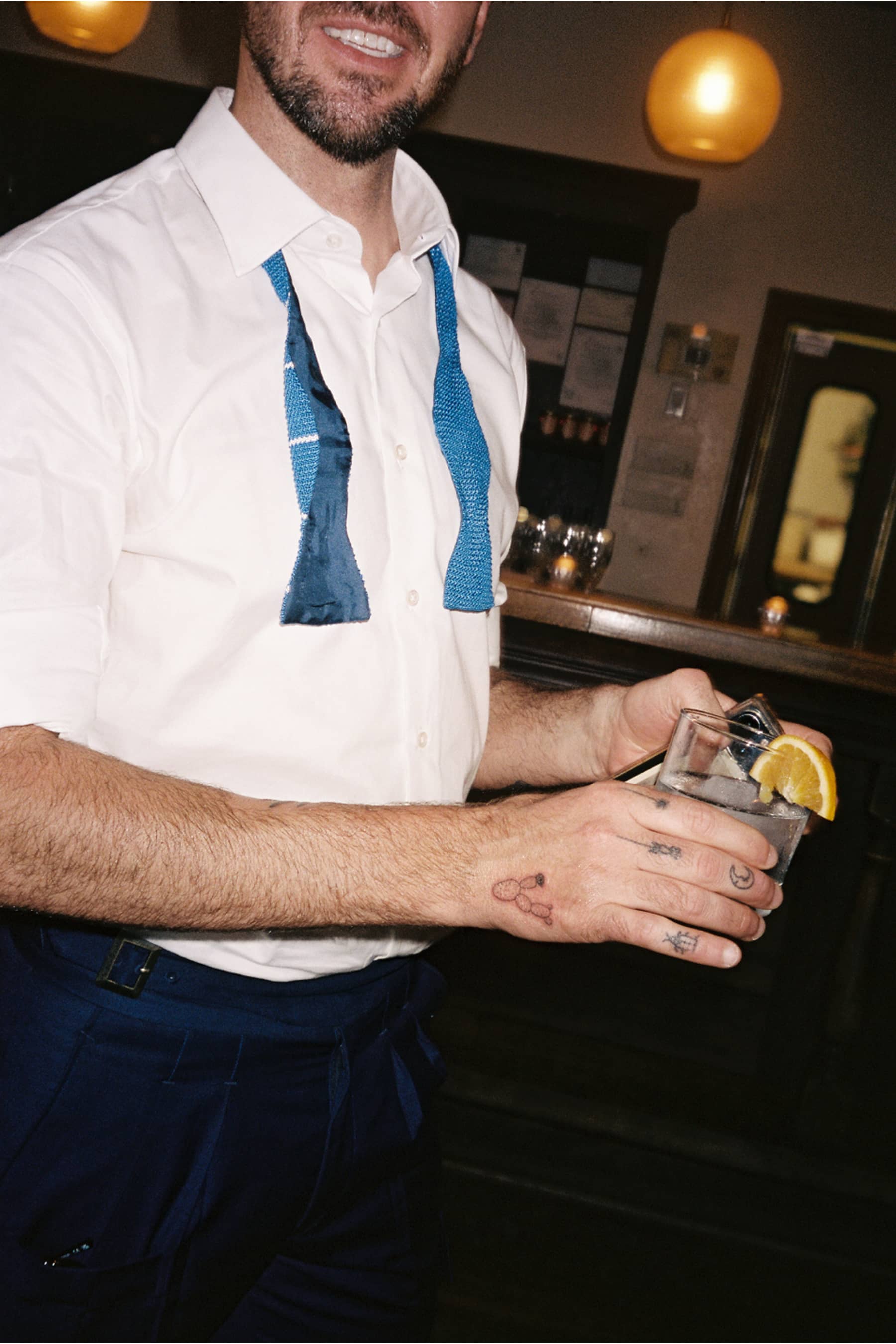
A live tattoo station at a wedding is a licensed crew setting up a clean, professional station at the venue and tattooing real flash designs on guests during a set window — usually 2–4 hours during the cocktail hour or reception. Couples book a company (not a solo freelancer), choose or commission a custom flash sheet, and pay a flat fee of $1,500–$6,500 depending on team size and hours. The artists handle safety, waivers, and aftercare. The line keeps moving because the designs are pre-drawn, and guest participation runs 20–30% of attendees.
This guide answers every question couples ask before booking a wedding tattoo station. The 14 questions below cover cost, timing, family politics, design, participation, and what to expect on the day. If you are still in research mode, this is the page that gets you to a decision.
On this page
- Will a tattoo station overshadow the wedding?
- Rehearsal dinner or reception: which works better?
- What is custom flash for couples?
- Should we get matching tattoos?
- What do older relatives think?
- What percentage of guests actually get tattooed?
- How much does a wedding tattoo station cost?
- What do the photos actually look like?
- What is the day-of timeline?
- Do guests need to be 18+?
- What if a guest has been drinking?
- How do we brief the wedding party?
- What is included in a wedding proposal?
- How far in advance should we book?
1. Will a tattoo station overshadow the wedding?
No — and the data backs it up. A tattoo station is a side activity, not a main event. Guests walk up, browse flash, get tattooed in 10–25 minutes, and return to the bar, the dance floor, or their table. The setup sits in a corner, a side room, or a tented area. It does not interrupt the ceremony, the toasts, or the first dance.
The couples who worry about this are usually the ones whose families have not seen a live tattoo station before. After the first guest walks out with a small design on their forearm, the social proof takes over. By the second hour, the line forms on its own.
Two design choices keep the station in its lane:
- Location matters. Tuck the setup out of the main reception sightline. A side room, a covered patio, a corner of the cocktail hour space, or a private lounge. The couple should be able to choose whether the station is part of the visible experience or a separate "discovery" moment.
- No main-stage energy. The artists work quietly. No music, no microphone, no announcement. Guests find the station because other guests are coming back from it with fresh work.
The couples who book tattoo stations are not couples who want a gimmick. They are couples who want a single, considered detail that the wedding did not already cover. The tattoo station does not compete with the photographer, the florist, the band, or the food. It is a different layer.
2. Rehearsal dinner or reception: which works better?
Both work. The decision comes down to three things: guest count, age range, and how visible you want the station to be.
Rehearsal dinner (40–80 guests):
- Tighter crowd, more intimate
- Guests are looser, more willing to participate
- Couples often use the rehearsal dinner for a more personal flash sheet: inside jokes, family references, the wedding location
- Lower cost because the artist team is smaller (1–2 artists, 2–3 hours)
- Older relatives who did not attend the rehearsal dinner are not in the room
Wedding reception (80–200 guests):
- Larger station, 2–4 artists, 3–4 hours
- Higher throughput, 24–80 tattoos in the window
- Works best when tucked into a side room or covered area
- The couple has more flexibility on the design (larger audience, more styles to choose from)
- The "discovery" effect is stronger because guests do not expect it
Most couples book the reception. The rehearsal dinner is a strong second choice for couples who want a smaller, more personal moment with the inner circle before the public event. A few couples book both: a 2-hour rehearsal dinner station on Friday and a 4-hour reception station on Saturday. The artists reuse the same flash sheet across both nights.
The short answer: if you can only book one, book the reception. The larger guest count and the natural rhythm of a wedding (ceremony → cocktail hour → reception) creates more touchpoints for the station.
3. What is custom flash for couples?
Custom flash is a sheet of 10–30 pre-drawn designs created specifically for your wedding. The couple works with the artist team 4–6 weeks before the event to define the visual direction. The artists then draw the designs at a fixed size, with one price per design on the menu board.
Common custom flash directions:
- Wedding monogram. The couple's initials in a custom typeface, often inside a small frame or botanical border.
- Wedding date in numerals. "6.28.26" or "06.28.2026" in a chosen typography. Clean, legible, small.
- Coordinates. Latitude and longitude of the venue, the first-date location, or the proposal spot. Often the most popular design of the night.
- Wedding venue icon. A small line drawing of the venue: the bell tower, the bridge, the oak tree, the rooftop skyline.
- Couple's dog, cat, or pet. A mini portrait drawn from a photo. Universally popular.
- Inside jokes. The cocktail they invented, the band they saw on their first date, the city they lived in, the trip that made them decide to marry. These land the hardest.
- Celestial motifs. The moon phase on the wedding date, the constellation of the wedding night, a single star.
- Botanical details. A sprig from the bridal bouquet, the groom's boutonniere flower, the venue's signature plant.
The cost of custom flash is usually included in the proposal for weddings. The lead time is 4–6 weeks, enough for the artists to draw, revise once, and print the final sheet. Custom flash is the single biggest driver of guest participation because every design is something the wedding owns, not something a guest could have gotten at a walk-in shop.
4. Should we get matching tattoos?
This is a personal decision, but a few patterns show up across hundreds of weddings.
The case for matching tattoos:
- The couple gets a shared mark on the same day, in the same room, in front of the people who matter most
- The design becomes a private reference point for the rest of the marriage
- The photos of the couple getting tattooed together are some of the most-shared images from the wedding
- The matching piece can sit anywhere: ring fingers (inside or outside), wrists, forearms, ankles, behind the ear
The case against matching tattoos:
- Matching locks both people into a single design decision for life
- A subtle difference (one gets a star, the other gets a moon) reads as a "set" without forcing identical placement
- Some couples prefer to keep the matching piece as something they do on a later anniversary, not the wedding day itself
The hybrid move many couples make:
- A matching or complementary design as one of the flash sheet options, available to all guests
- The couple gets tattooed first, in a private window before the station opens
- The flash design becomes "their" design, but other guests can also get it
If you want matching tattoos, do them. If you want complementary tattoos (his-and-hers variations on a theme), do that. If you want neither, skip the matching piece and let the flash sheet be the only tattoo story of the night.
5. What do older relatives think?
The honest answer: most older relatives are curious, not opposed. The ones who are opposed were going to be opposed to something else on the wedding day too.
Here is what we have seen across hundreds of weddings:
- Grandparents. The 60+ crowd is the most likely to be skeptical in theory and the most moved in practice. Several grandparents per wedding end up getting a small piece, usually a date, an initial, or a tiny symbol of the couple. The 70-year-old woman at one wedding who got her first tattoo after a 50-year consideration period is the most-cited photo from our archive.
- Parents. Split. The 50-something crowd is more divided. The parents who lean in are usually parents who have a tattoo themselves. The parents who push back are usually parents who do not. The right move is to brief the parents in advance: what the setup looks like, what the safety standards are, that the artists will turn away anyone who has been drinking, and that no one is pressured.
- Aunts, uncles, cousins. The middle of the guest list is the easiest segment. They show up, they look at the flash, they either get tattooed or they do not. No friction.
How to brief the older relatives:
- Explain the setup in advance, in one sentence: "We are having 2 professional tattoo artists set up a station during the reception, with a curated menu of small designs."
- Make participation opt-in, not opt-out. The station is not announced during the toasts. Guests find it on their own.
- Show one example of the flash sheet in advance. Once they see the small, tasteful scale of the designs, the concern usually drops.
- Confirm that the artists will turn away anyone who has been drinking. This is the single biggest objection from older relatives, and it is the easiest to address.
The couples who skip the briefing are the couples whose mothers call them the next morning. The couples who brief the family in advance get calls about something else.
6. What percentage of guests actually get tattooed?
Across hundreds of weddings, 20–30% of guests get tattooed. The range is wide because the percentage depends on five variables.
What pushes participation up:
- Custom flash sheet (vs. generic flash)
- 2+ artists (the line stays short)
- 3+ hour window (the late-night crowd participates)
- Open bar with responsible RBS-trained staff
- Younger guest list (25–40 year olds participate at 30–40%)
- Word-of-mouth momentum (the first 20 tattoos trigger the next 40)
What pushes participation down:
- 1 artist with a 2-hour window
- Generic flash with no wedding-specific designs
- Older guest list (60+ year olds participate at 5–10%)
- A station location guests cannot find
- A ceremony-reception gap shorter than 60 minutes
Realistic numbers by wedding size:
- 50 guests — 1 artist, 2 hours — 6–10 tattoos — 12–20% participation
- 100 guests — 2 artists, 3 hours — 18–30 tattoos — 18–30% participation
- 150 guests — 3 artists, 4 hours — 36–60 tattoos — 24–40% participation
- 200 guests — 4 artists, 4 hours — 48–80 tattoos — 24–40% participation
The participation rate is a feature, not a bug. Couples do not want 100% of their guests tattooed. They want a station that is active, well-used, and not overwhelming. 20–30% is the sweet spot.
7. How much does a wedding tattoo station cost?
$1,500–$6,500 for the most weddings in 2026. The wide range is driven by four variables:
1. Hours. 2 hours costs less than 4 hours. Most couples book 3 hours.
2. Number of artists. 1 artist covers 3–5 guests per hour. 2 artists cover 6–10. 3 artists cover 9–15. 4 artists cover 12–20. Most weddings book 2–3 artists.
3. Travel. Local events (within 30 miles of the company's base) include travel in the base fee. Destination weddings, multi-day events, or remote locations add $300–$1,500 per artist for flights, hotels, and per diem.
4. Design complexity. A curated flash sheet from existing artwork is included. A fully custom sheet designed from scratch for 1 couple adds $200–$800 in design time. Most couples go custom.
Realistic 2026 pricing:
- Cocktail hour — 2 hours, 1 artist — 6–10 guests — $1,200–$2,000
- Standard reception — 3 hours, 2 artists — 18–30 guests — $2,500–$3,800
- Large reception — 4 hours, 3 artists — 36–60 guests — $3,800–$5,500
- Full event — 5+ hours, 4 artists — 60–100 guests — $5,500–$6,500
- Destination add-on — +$300–$1,500 per artist
The proposal includes the artists, the setup, the breakdown, the flash design, the aftercare kits, the insurance, and the permits. No add-ons. No surprise line items. A 25–50% deposit locks the date; the balance is due 30 days before the wedding.
8. What do the photos actually look like?
Couples ask this in every first call. Here is what the station looks like across the four most common formats.
The lounge setup. A hotel suite, a private room, or a designated corner of the venue. Two tattoo chairs or massage tables, a privacy screen, a handwashing station, a check-in table with a tablet for waivers, and a flash sheet displayed on an easel or iPad. Lighting is warm. Music is optional. The station looks like a small studio that belongs to the venue.
The patio setup. A covered patio, a tented area, or an outdoor lounge. Same equipment, plus a canopy for weather protection and additional lighting. The setup works for outdoor weddings, vineyard weddings, and beach weddings.
The cocktail hour setup. A 10×10 corner of the cocktail hour space. One artist, a portable station, a small flash menu. Higher visibility than the lounge setup, lower footprint. Works for smaller weddings or couples who want the station to be part of the visible experience.
The late-night setup. A separate room or a corner of the dance floor area. One or two artists, a 2-hour window starting after dinner. The after-party crowd is more willing to participate than the dinner crowd. This format is the most popular for couples who want the station to peak after the toasts.
What the guests look like. Mostly smiling. Some guests are nervous going in and laughing coming out. A few guests cry, usually the ones getting a memorial piece or a parent's name. Most guests take a photo of the finished tattoo and send it to someone not at the wedding within 5 minutes. The first-tattoo rate at weddings runs 50–60%. More than half of the guests who get tattooed have never been tattooed before.
What the couple looks like. If the couple gets matching tattoos, the photos usually run during a private window before the station opens. The artist team sets up first, tattoos the couple, then opens to guests. The couple's photos are typically shot against a clean background or a wall with the flash sheet visible.
9. What is the day-of timeline?
8–12 weeks out. Shortlist 3–5 services. Request quotes. Confirm date availability.
8 weeks out. Sign a contract. Pay the deposit (25–50%). Confirm the custom flash direction with the artist team.
4 weeks out. Review the final flash sheet. Confirm hours, station location, and guest count. Send the venue's insurance requirements to the tattoo company. Pay the remaining balance.
1 week out. Confirm arrival time, setup window, and the on-site contact. Brief the wedding planner or day-of coordinator on the station location, signage, and any guest-facing communication.
Day of:
- T-3 hours: Artist team arrives at the venue.
- T-2 hours: Setup complete. Flash sheet, aftercare kits, sanitation station, check-in table, and tattoo stations are ready.
- T-1 hour: Couple's private window (optional). The couple gets matching or complementary tattoos before the station opens.
- T-0: Station opens to guests. Check-in host verifies ID (18+ for permanent), screens for alcohol consumption, and confirms the waiver.
- T+2 to T+4 hours: Station runs. Artists tattoo one guest at a time. Assistant preps the station between clients. Check-in host manages the line.
- T+end: Station closes. Last guest gets aftercare instructions. Artists break down in 30–45 minutes. Venue is left clean with no trace.
The artist team runs the entire operation. The wedding planner, the venue coordinator, and the couple do not manage the line, the waivers, or the aftercare. The crew handles it.
10. Do guests need to be 18+?
Yes, for permanent tattoos. No exceptions. Every guest shows ID at check-in. The check-in host verifies the ID, scans it if required by the jurisdiction, and confirms the waiver.
Couples occasionally ask if a parent can sign for a minor. The answer is no. A parent can sign a school field trip form. A parent cannot sign a tattoo waiver. The artists turn away any guest under 18, including the children of the couple.
For guests who want to participate without the age requirement or the lifetime commitment, the artist team can bring a temporary or semi-permanent option. Temporary tattoos (jagua-based, 2–4 weeks) are available for guests of any age. Semi-permanent tattoos (water-applied, 24 hours) are available for guests who want the experience without the permanence.
11. What if a guest has been drinking?
The artists turn away any guest who is visibly intoxicated. This is a hard rule, not a judgment call. The check-in host is RBS-trained (Responsible Beverage Service) and screens every guest at check-in. The artists also have the right to stop a tattoo mid-session if a guest's behavior suggests impairment.
This is the single most-asked safety question from couples and from older relatives. The answer is the same: no one who is impaired gets tattooed, period. The artists would rather lose a tattoo than risk a guest's safety or the company's insurance.
Couples who are worried about the open bar + tattoo station dynamic should know that the artists have run hundreds of weddings with open bars. The protocol works. The check-in host is trained. The artists are experienced. The line moves quickly enough that the wait itself keeps guests from over-drinking while they wait.
12. How do we brief the wedding party?
A 5-minute conversation is enough. The wedding party does not need a full safety briefing. They need to know three things:
- The station exists. "We have a tattoo station set up in the [side room / patio / corner] from [start time] to [end time]. 2 artists, curated flash, no pressure."
- The artists handle everything. "The artists run the station. They check IDs, screen for drinking, and manage the line. We don't need to do anything."
- The first question to ask a curious guest: "Want to see the flash sheet?" Not "Are you getting one?"
The last point matters. Couples who announce the station with an "everyone is getting one" energy create social pressure that the artists then have to manage. Couples who frame it as a side discovery ("there's a station in the corner, take a look if you want") get higher participation with less friction.
13. What is included in a wedding proposal?
A complete proposal includes everything a couple needs to make a decision. From Tattoo Popups, the proposal includes:
- Availability for the wedding date
- A custom quote based on hours, location, guest count, and team size
- A sample contract with the scope of work, deposit terms, and cancellation policy
- The certificate of insurance ($2M liability, with the venue named as additional insured on request)
- The 12-point safety checklist that the artists follow on-site
- A flash sheet preview showing the kind of designs the artists draw for weddings
- 3–5 references from past weddings the couple can contact
- The setup footprint (10×10 per artist, 15-amp outlet, access to a sink)
- The day-of timeline with arrival time, setup window, and breakdown details
The proposal is sent within 24 hours of the first call. No pressure, no follow-up sequence, no urgency play. Couples take the proposal to their wedding planner, compare it to the other services they are considering, and decide on their own timeline.
14. How far in advance should we book?
8–12 weeks is the standard lead time. Peak wedding season (May–October in the Northern Hemisphere) books out 12–16 weeks in advance. Off-peak (November–April) can be booked 6–8 weeks out.
The lead time is driven by three things:
- Custom flash design. 4–6 weeks for the artists to draw, revise, and finalize the sheet.
- Venue compliance. Some venues require insurance certificates, health department documentation, and a setup walkthrough 4–6 weeks before the event.
- Permit processing. Some jurisdictions (LA County, NYC, Miami-Dade) require a mobile body-art permit 4–8 weeks before the event.
Couples who book 8–12 weeks out have full access to the date, the design library, and the lead artist team. Couples who book 4–6 weeks out usually get the date but may have a smaller design selection and a shorter flash design window. Couples who book 2–4 weeks out take whatever artist team is available and accept a curated (not custom) flash sheet.
The earliest a couple can book is 12 months out. Tattoo Popups holds a calendar that opens 12 months in advance for weddings.
Where we work: weddings in Los Angeles, New York, and Miami
Tattoo Popups runs wedding tattoo stations across the country's busiest wedding markets. We are actively booking weddings in Los Angeles, weddings in New York, and weddings in Miami, plus destination events nationwide. Each market has its own permit process, its own health-department requirements, and its own lead-time considerations. Our crews handle all of it.
If you are still comparing wedding entertainment options, start with our 25 unique wedding entertainment ideas for 2026, then read the how to hire a tattoo artist for your wedding breakdown, and check how much a tattoo popup costs so you know what drives the proposal.
Plan your wedding.
A wedding tattoo station is the single most personal favor a guest will ever receive from a couple. It is also the only one they will still be wearing 10 years from now.
If you are ready to book, request a wedding proposal. We send one within 24 hours with availability, a custom quote, the insurance certificate, the safety checklist, and a sample contract. No pressure, no follow-up sequence. Just the information you need to make a confident decision.