Are Tattoo Popups Safe? Safety, Licensing, and What Venues Need to Know
Yes, tattoo popups are safe. A licensed event tattoo crew operates under the same health-department regulations as a brick-and-mortar tattoo studio — single-use needles, autoclave-sterilized equipment, EPA-registered surface disinfection, OSHA bloodborne pathogen training, $2M professional liability insurance, and a verifiable sterilization protocol for every guest. The difference between a professional popup and a risky one is documentation. The crew carries licenses for every artist, a mobile body-art permit, a certificate of insurance naming your venue as additional insured, and a written safety checklist your legal team can review before signing.
This guide is the tattoo popup safety documentation we send to venue legal teams, brand counsel, and event planners who need event tattoo safety in writing. It covers licensing by market (LA, Las Vegas, NYC, Miami), bloodborne pathogen certification, the single-use sterilization protocol, the $2M COI structure, alcohol screening, age verification, the touch-up guarantee, and the venue compliance checklist. Send this page to your legal team. Then book a call.
For the deeper breakdown of how the crew actually operates at events, see our event tattooing overview. For pricing context behind the safety stack, see how much a tattoo popup costs. If you are hosting a wedding, the wedding tattoo guide covers the same safety standards in a couple-facing format; for corporate and brand events, see the corporate tattoo guide. For the operational run-of-show, see how to plan a tattoo popup.
On this page
- Are tattoo popups safe? The short answer
- What "safe" means for an event tattoo
- Licensing by market (LA, Vegas, NYC, Miami)
- Bloodborne pathogen (BBP) certification
- $2M certificate of insurance (COI)
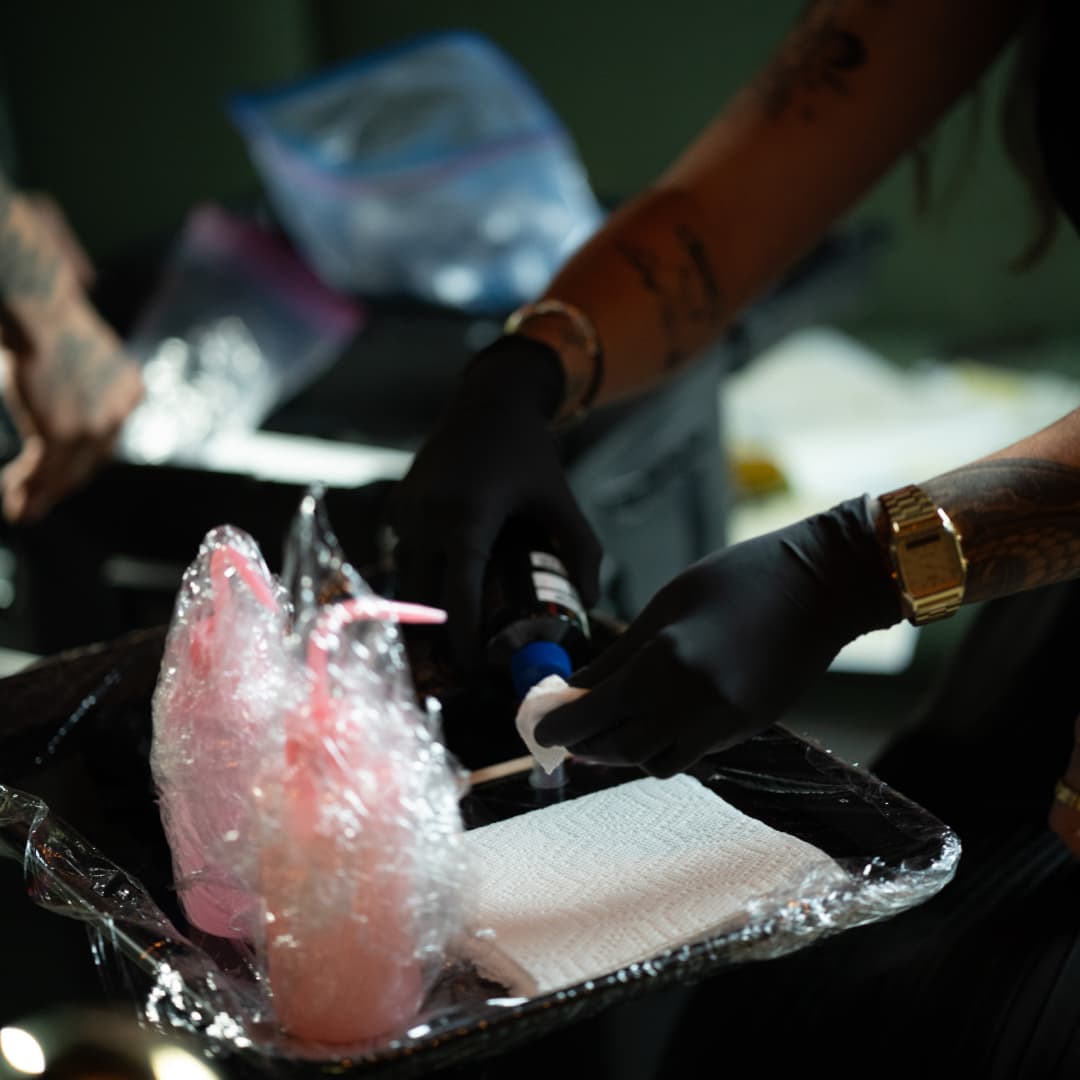
- Single-use sterilization protocol
- Alcohol screening process
- Age verification (18+)
- Touch-up guarantee
- Venue compliance checklist
- What makes a tattoo popup unsafe
- What to send your legal team
- How a professional crew works day-of
- What insurance underwriters want to see
- Why documentation matters
- What happens if something goes wrong
Are Tattoo Popups Safe? The Short Answer
Yes — tattoo popups are safe when the crew meets a documented bar. A professional event tattoo crew operates under the same health-department standards as a brick-and-mortar studio: single-use needles, autoclave-sterilized reusable equipment, EPA-registered surface disinfection, OSHA bloodborne pathogen training, $2M professional liability insurance, and a written sterilization protocol the venue's legal team can review before signing. Tattoo popup safety lives in the paperwork. If the crew can produce the documentation on demand, the popup is safe. If they cannot, it is not.
What "Safe" Means for an Event Tattoo
Safety at a tattoo popup comes down to 5 things the crew can prove with documents:
- Every artist holds an active license in the state and county where the event takes place.
- Every piece of equipment that touches skin is single-use or sterilized in a medical-grade autoclave between guests.
- The crew carries professional liability insurance that names the venue and the client as additional insureds.
- Check-in staff screen every guest for age (18+) and alcohol consumption before they sit in the chair.
- The crew follows a written sterilization and aftercare protocol that holds up to a health-department inspection.
If any of these 5 are missing, the popup is not safe to host. If all 5 are present, the popup operates at the same standard as a licensed tattoo shop — and a temporary event has the added advantage of running on a fresh setup with no carryover between days.
Licensing by Market: Event Tattoo Safety by City
Tattoo licensing in the United States is local. Each state, and often each county or city, sets its own requirements. The crew confirms credentials for every artist before the booking. Here is how the major event markets work in 2026.
Los Angeles, California
- State license: California Body Art Practitioner License, issued by the California Department of Public Health. Every artist who touches skin must hold a current license with the practitioner's photo, license number, and expiration date.
- County permit: Los Angeles County requires a body-art facility permit for any location where tattooing occurs, including temporary event venues. The county health department inspects the setup on request.
- Mobile authorization: The mobile permit is held by a sponsoring body-art facility. The crew works under that facility's permit for the duration of the event.
- Lead time: 4-6 weeks for the facility permit, longer for first-time venues that require an on-site inspection.
Las Vegas, Nevada
- State license: Nevada State Health Division body-art license. Issued by the Nevada Division of Public and Behavioral Health.
- County permit: Clark County requires a Special Event Permit for any tattooing at a temporary location, plus a body-art establishment license under which the mobile crew operates.
- Venue coordination: The venue submits the Special Event Permit application with the crew's documentation attached. Lead time is 6-8 weeks.
- Inspection: Clark County environmental health inspects the setup on event day. The crew prepares the station to pass inspection on the first walk-through.
New York City
- State license: New York State Tattoo License, issued by the Department of Health. NYC requires both a state and a city credential.
- City permit: NYC Department of Health issues a temporary body-art permit for events. The application includes a layout of the setup, the sterilization protocol, the artist roster, and proof of insurance.
- Lead time: 8-12 weeks. NYC is the most permit-intensive market in the country. Plan ahead.
- Restrictions: NYC restricts tattooing to certain body areas and prohibits tattooing in establishments that hold a liquor license as the primary use. Events at hotel ballrooms, brand activations, and private venues clear without issue.
Miami / Miami-Dade, Florida
- State license: Florida Department of Health Tattoo Artist License. The state requires each artist to hold an active license with current continuing-education credits.
- County permit: Miami-Dade County requires a Tattoo Establishment License for any location where tattooing occurs. The mobile crew operates under a sponsoring establishment's permit.
- Lead time: 4-6 weeks for the establishment permit. Some venues require a pre-event site visit from the county health department.
- Hospitality coordination: Miami runs a high volume of hotel and brand activations. The crews that work Miami regularly have the permits, the artist roster, and the relationships to keep the lead time tight.
For all other markets, the crew confirms local requirements before booking. Some states (Arizona, Colorado, Washington) require practitioner licenses. Others (Massachusetts, Connecticut) restrict tattooing to licensed establishments. The crew confirms the rules for the specific venue, the specific date, and the specific city.
Bloodborne Pathogen (BBP) Certification
Every crew member completes OSHA Bloodborne Pathogen training annually. The certification covers:
- The epidemiology and symptoms of bloodborne diseases (HIV, hepatitis B, hepatitis C)
- The transmission routes for bloodborne pathogens
- The methods to prevent or reduce exposure (standard precautions, personal protective equipment, engineering controls)
- The post-exposure procedures if a needlestick or splash incident occurs
- The biohazard waste handling protocol for sharps containers and medical waste
The BBP certificate is current within 12 months and dated before the event. The crew keeps a copy of every certificate on file and shares them with venue legal teams on request.
RBS (Responsible Beverage Service) certification is a related credential that the check-in hosts carry at every event with an open bar. RBS training covers recognizing signs of intoxication, refusing service professionally, and documenting incidents. The check-in host uses the same screening framework at the tattoo station: any guest who shows signs of impairment does not get tattooed.
$2M Certificate of Insurance (COI): The Tattoo Popup Safety Anchor
Professional event tattoo crews carry $2M in professional liability insurance per occurrence. The Certificate of Insurance is the single document venue legal teams ask for first, and it is the anchor of the entire tattoo popup safety package. The COI includes:
- General liability: $2M per occurrence, $4M aggregate. Covers third-party bodily injury and property damage.
- Professional liability: $1M per claim. Covers errors and omissions in the tattooing service.
- Workers' compensation: Statutory limits for the state where the event takes place. Covers the crew if an artist is injured on-site.
- Additional insureds: The venue and the client are named as additional insureds on the general liability policy on request. The venue's insurance team reviews the endorsement language before signing.
- Primary and noncontributory wording: The crew's policy responds first, before the venue's policy, in the event of a claim.
The COI is delivered with the proposal. The crew's insurance broker is available to issue custom certificates for venues with specific endorsement requirements. Most venue contracts require 30-60 days' lead time for certificate issuance, so send the contract early.
Single-Use Sterilization Protocol
The sterilization protocol runs the same way at every event, on every guest, in every market. The crew follows the protocol from setup through breakdown.
Setup (2 hours before first guest)
- Surfaces wipe down with EPA-registered hospital-grade disinfectant (quaternary ammonium or bleach solution).
- Barrier film applied to every surface the artist touches — armrests, machine grips, bottle surfaces, cord wraps.
- Autoclave runs a spore test on the day of the event. The crew carries a printed spore-test log showing negative results within the last 30 days.
- Single-use supplies are laid out for the first 10 guests: needles, tubes, ink caps, gloves, razors, gauze, barrier film.
- Sharps container is in place, sealed, and labeled with the date and the crew's medical waste hauler information.
Between every guest
- Artist removes gloves and disposes in the biohazard bag.
- Fresh gloves go on before touching the next guest.
- Single-use needle cartridge opens in front of the guest. The artist shows the sealed package and the expiration date.
- Used needle disposes in the sharps container immediately after the tattoo.
- Tubes and grips go into the autoclave tray if reusable, or the biohazard bag if single-use.
- Surfaces wipe down with EPA-registered disinfectant. Barrier film changes if visibly soiled.
- Ink caps, rinse cups, and razors dispose in the biohazard bag. New ink comes from sealed bottles for every guest.
- Inks are FDA-approved, vegan, and single-pigment. Named manufacturers only. No mystery bottles.
Breakdown (30-45 minutes after last guest)
- Sharps container seals and labels with the date, the venue, and the event name.
- Medical waste bag seals and stores with the sharps container for pickup by the medical waste hauler.
- Autoclave runs a final cycle on reusable equipment. Equipment returns to the studio in a sealed transport bag.
- Surfaces wipe down and barrier film disposes.
- Station breaks down with no trace left at the venue.
The protocol is verifiable. The crew carries the spore-test log, the autoclave maintenance log, the medical waste hauler receipt, and the EPA disinfectant safety data sheets (SDS). Venue and brand teams can request these documents before the event.
Alcohol Screening Process
Tattooing a guest who has been drinking is unsafe. Alcohol thins the blood, increases bleeding, and impairs the guest's ability to consent. The crew screens every guest at check-in.
The check-in host is RBS-certified and uses the same framework a bartender uses to assess intoxication. The screening is brief, friendly, and consistent:
- Visible signs: Bloodshot eyes, slurred speech, unsteady gait, flushed face, glass in hand, or signs of recent consumption.
- Self-disclosure: The guest states they have not been drinking, or the guest states they have had 1-2 drinks in the last hour.
- Observation: The host has watched the guest in the room for at least 10 minutes.
If the host assesses the guest as impaired, the host explains the policy clearly: we don't tattoo anyone who has been drinking. It is a safety issue, not a judgment. The host offers the guest a non-alcoholic drink, water, and a place to sit. The guest can return later in the night when sober. The crew tattoos no one under the influence.
For events with a bar, the crew coordinates with the bartending team before the event. The tattoo station sits 30+ feet from the main bar when possible. The check-in host has discretion to defer any guest to later in the window.
Age Verification (18+)
Permanent tattooing at events is 18+, no exceptions. The check-in host verifies ID for every guest before they sit in the chair.
- Accepted IDs: Government-issued photo ID — driver's license, passport, state ID, military ID. The host checks the photo, the date of birth, and the expiration date.
- Refused IDs: Expired IDs, vertical IDs from states that issue horizontal IDs to adults, school IDs, work IDs.
- Process: The host scans or photographs the ID on the tablet, confirms the date of birth shows the guest is 18+, and confirms the waiver signature matches the ID name.
- Refusal: If the guest cannot produce a valid ID, the crew tattoos no one. The host offers temporary or semi-permanent options if those are available at the event.
Temporary and semi-permanent options may have different age rules depending on the venue and the jurisdiction. The default is 18+ for any service, but the check-in host confirms before offering alternatives.
Touch-Up Guarantee
The crew guarantees the work for 30 days. If a tattoo heals unevenly, drops a line, or needs a touch-up for any reason, the guest contacts the crew within 30 days of the event and the crew books a touch-up at no charge. Most touch-ups happen at a partner studio in the guest's city, or at a follow-up event in the same market.
The touch-up policy is rarely used. Across thousands of tattoos, the touch-up rate runs under 2%. The low rate reflects the crew's quality control: artists work in clean conditions, with fresh equipment, on rested guests, in a controlled environment.
The crew's aftercare instructions cover the 14-day healing window. Guests leave with a printed aftercare card and a follow-up email with the same instructions. The instructions cover washing, moisturizing, sun protection, and what to avoid (soaking, picking, scratching). Guests who follow the instructions heal clean tattoos on the first pass.
Venue Compliance Checklist
The crew sends this checklist to every venue before the event. The venue's operations team, legal team, and insurance team review it. The crew confirms the checklist is complete before the load-in.
Permits and Licensing
- Mobile body-art permit issued for the venue and the date
- Every artist holds a current state body-art license for the event's state
- Every artist holds a current county or city credential where required
- BBP certificates for every crew member, current within 12 months
- RBS certificates for check-in hosts at events with a bar
Insurance
- $2M general liability insurance, per occurrence
- $1M professional liability insurance, per claim
- Workers' compensation insurance for the state
- Venue named as additional insured on the general liability policy
- Client named as additional insured on request
- Primary and noncontributory wording on the general liability policy
Setup
- 10×10 ft minimum footprint per artist
- Access to a 15-20 amp circuit within 25 feet of the station
- Access to a handwashing sink within 25 feet, or a portable handwashing station
- Waste disposal access for biohazard bags and sharps containers
- Climate-controlled space (the station runs at 70-75°F for guest comfort)
- ADA-compliant path to the station for guests with mobility devices
Day-Of Operations
- Venue contact on-site during setup, the event, and breakdown
- Load-in access 2 hours before the first guest
- Load-out access 30-45 minutes after the last guest
- Secure storage for equipment during breaks if the event pauses
- Coordination with the bar team on alcohol screening
- Coordination with security on ID verification and guest flow
Documentation On-Site
- Spore-test log for the autoclave (negative within 30 days)
- EPA disinfectant SDS sheets
- Medical waste hauler manifest
- Insurance certificates in printed form
- Artist license copies in printed form
- Aftercare cards for every guest
The crew confirms every box is checked before load-in. Venues with internal compliance teams can request a copy of the checklist signed by the crew lead before the event starts.
What Makes a Tattoo Popup Unsafe
The same standards that make a popup safe define when a popup is unsafe. The crew turns down bookings that don't meet the bar, and venues should turn down crews that don't meet the bar. The 5 red flags:
- No insurance certificate. A crew that can't produce a $1M+ COI on request is not qualified for private events. The venue's insurance policy excludes unlicensed contractors.
- No state license. Every artist who touches skin holds a state license in the event's state. An apprentice, a guest artist from out of state, or an artist with an expired license is a health-department violation and a liability.
- Reusable needles or "saved" equipment. Single-use needles are non-negotiable. A crew that reuses needles, cartridges, or tubes is operating outside the law.
- No screening for alcohol or age. A crew that doesn't check IDs and doesn't screen for sobriety is exposing guests and the venue to liability.
- No aftercare or follow-up. A crew that disappears after the event is not a professional crew. The aftercare instructions, the touch-up guarantee, and the 30-day follow-up are part of the service.
If a vendor hits any of these 5, find another vendor. The bar is the bar.
What to Send Your Legal Team
A short, complete document set clears the legal review in one pass. The crew's standard package includes:
- Certificate of Insurance with the venue and the client named as additional insureds
- Mobile body-art permit for the venue, county, and date
- Artist license list with license numbers and expiration dates
- BBP certificates for every crew member
- Sterilization protocol (this page, or a PDF version)
- Venue compliance checklist (signed)
- Medical waste hauler manifest and contract
- Sample guest waiver with the consent, release, and aftercare language
- Touch-up guarantee in writing
Legal teams typically review this package in 3-5 business days. Some venues require a 30-day review window. Send the package 4-6 weeks before the event to give the venue time to clear the booking. Planners who want a turnkey packet to forward internally can start from the planner resource hub or pull the common safety FAQs before sending the documentation.
How a Professional Crew Works Day-Of
The setup runs the same way at every event. Venues see the same flow at every booking.
Load-in (2 hours before first guest). The crew arrives, sets up the station, runs the autoclave cycle, lays out single-use supplies, and confirms the layout with the venue contact. The setup is invisible to guests — the station looks clean, professional, and ready.
Check-in (open of window). The check-in host greets each guest, verifies ID, screens for alcohol, and confirms the waiver. Guests with confirmed consent move to the design station.
Design selection (5-10 minutes per guest). Guests pick from 10-15 flash designs on the menu board or iPad. The artist confirms the placement and the size. The assistant preps the station.
Tattoo (15-30 minutes per guest). The artist tattoos one guest at a time. The assistant handles setup, breakdown, and supply runs. The check-in host manages the line. Most flash tattoos finish in 15-30 minutes.
Aftercare (5 minutes per guest). The assistant walks the guest through the aftercare card, hands over the aftercare kit, and confirms the follow-up email. The guest leaves with instructions and a contact for any questions.
Load-out (30-45 minutes after last guest). The crew breaks down the station, seals the medical waste, packs the autoclave, and leaves no trace. The venue space looks the way it did before the crew arrived.
The system is built so the venue's operations team has nothing to manage. The crew runs the line, the waivers, the screening, the cleanup. The venue provides the space, the power, the sink, and the contact.
What Insurance Underwriters Want to See
Underwriters for venue events often ask for the same documentation the legal team asks for, in a different format. The crew's standard response:
- Coverage limits: $2M per occurrence, $4M aggregate general liability; $1M per claim professional liability
- Carrier rating: A.M. Best A- or better
- Additional insured endorsement: CG 20 10 or equivalent, with primary and noncontributory wording
- Waiver of subrogation: When required by the venue
- Claims history: Available on request
Underwriters clear the documentation in 5-10 business days. Some venues require the crew's insurance to be primary over the venue's policy, which the endorsement language covers.
Why Documentation Matters
The difference between a professional crew and an amateur is paperwork. The amateur has a portfolio. The professional has a portfolio, a license, a permit, an insurance certificate, a sterilization protocol, an autoclave log, a medical waste manifest, a BBP certificate, an RBS certificate, a waiver, an aftercare card, and a touch-up guarantee.
The paperwork is the proof. It is what the venue's legal team reviews, what the brand's compliance team reviews, and what protects the venue, the brand, and the guests if anything goes wrong. The crew that produces the paperwork is the crew that runs the safe popup.
What Happens If Something Goes Wrong
A professional crew prepares for incidents. The crew's incident protocol covers the rare cases when a guest has a reaction, an injury, or a concern after the event.
- Allergic reaction: A guest with a sensitivity to ink, latex, or adhesive contacts the crew within 24 hours. The crew refers the guest to a medical professional and follows up within 48 hours to confirm the guest is receiving care.
- Infection: A guest who shows signs of infection (redness, swelling, discharge outside the normal healing window) contacts the crew. The crew refers the guest to a medical professional and documents the case for the medical waste hauler, the insurance carrier, and the artist.
- Injury: A guest who is injured at the station (slip, fall, equipment failure) receives first aid on-site. The crew files an incident report, notifies the venue, and submits the claim to the insurance carrier within 24 hours.
- Unsatisfied guest: A guest who is unsatisfied with the work contacts the crew within 30 days. The crew books a touch-up at no charge, or refers the guest to a partner studio for a consultation.
The crew's incident protocol is on file with the insurance carrier, the medical waste hauler, and the venue. The crew lead on-site has the authority to make the call and the documentation to back it up.
Send This Page to Your Legal Team
This page is the documentation. It covers the licensing, the insurance, the sterilization protocol, the alcohol screening, the age verification, the touch-up guarantee, and the venue compliance checklist. A legal team can review it in 15 minutes and clear the booking in one pass.
For a custom certificate, a custom insurance endorsement, or a custom permit package, the crew's broker and legal team are available. Most custom requests clear in 5-10 business days. The full Safety & Standards experience page has the same documentation in a venue-facing format if your team prefers a separate URL.
Book a Call
The proposal tells you the cost, the crew, the flash design, and the timeline for your specific event. The safety documentation is in this post. The legal review is straightforward. The booking process is one call.
Active in Los Angeles, New York, Miami, Las Vegas, and destination events nationwide. Residencies in members' clubs and luxury hotels globally.