10 Brand Activation Ideas That Get Shared (Not Forgotten)
The 10 brand activation ideas below are built to be photographed, filmed, and shared by the people in the room. The list covers tattoo popups, immersive pop-ups, scent installations, AR experiences, custom merch drops, live muralists, interactive installations, projection mapping, flash mobs, and personalized product stations. Each one produces a takeaway a guest can hold, wear, post, or talk about on Monday. Ranked by half-life — how long the activation lives after the lights come up.
Most brand activations die in a recap deck. A logo on a step-and-repeat. A hashtag no one used. A 6-second story clip that disappears in 24 hours. The 10 ideas on this list are different because they produce content that compounds. The shared moment is the metric. The artifact is the asset. The reach is what makes the line item worth the proposal.
Last updated: June 29, 2026.
1. Tattoo Popup — The Only Artifact That Lasts
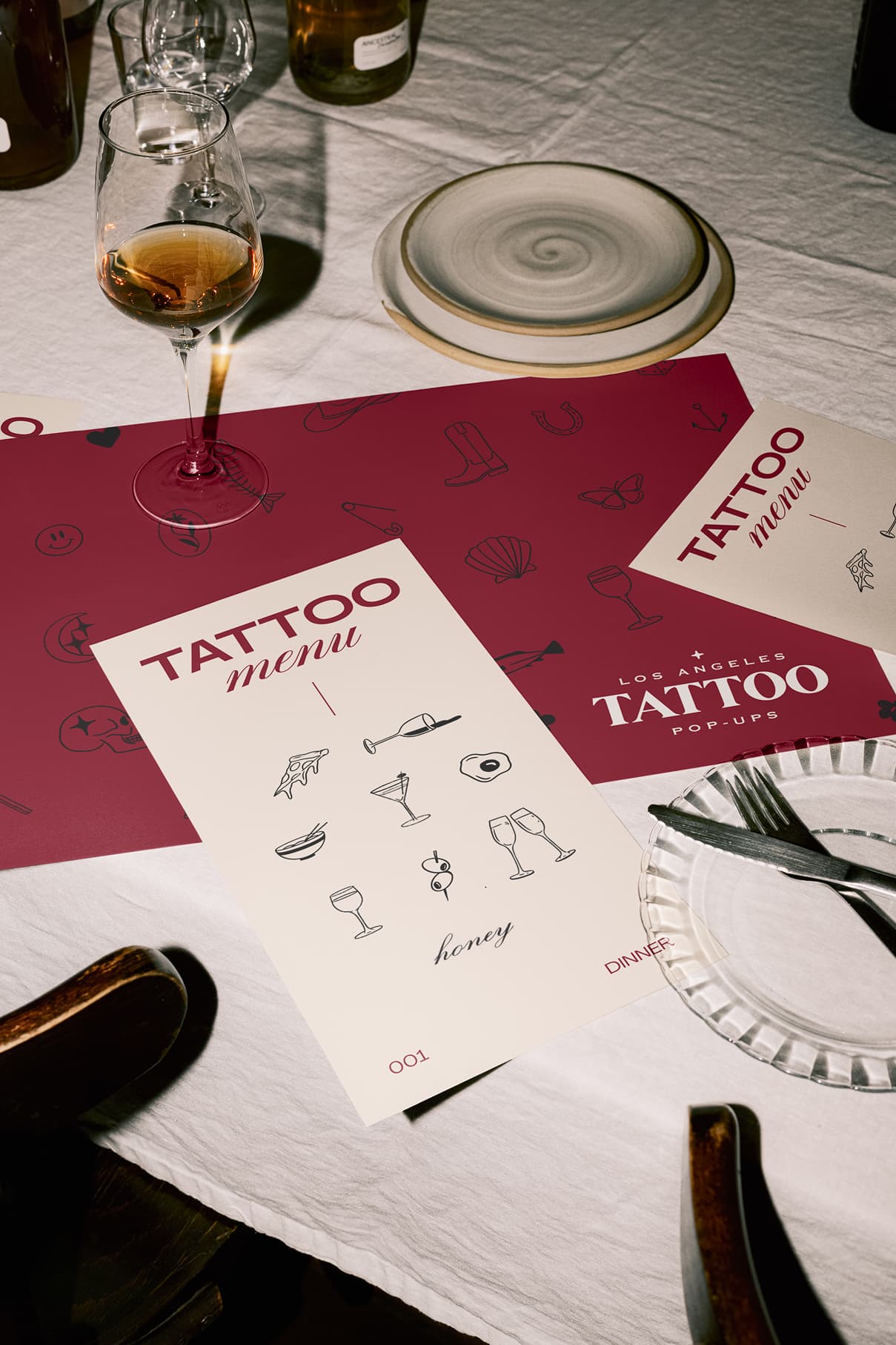
A tattoo popup is a licensed, insured crew of event-trained artists who set up a clean station at your event and tattoo guests from a custom flash sheet built for your brand. The guest walks in, picks a design from a curated menu of 8–12 options, and leaves with a real tattoo designed for the night they got it. The activation runs like a production. The output is permanent.
This is the only brand activation idea on this list with a multi-year half-life. The cocktails are gone by morning. The mural gets photographed and filed. The tattoo is on a forearm when someone pitches a client in 2030.
What it looks like on the floor. A 10×10-foot station near power and a washing area. A host on the line running a digital waitlist. 1–4 artists working in parallel, each producing 3–5 tattoos an hour — roughly 3× the industry average because the system around the artist matters as much as the artist. Assistants handle setup, breakdown, sterilization, and aftercare. A coordinator talks to your planner, your venue, and your brand team from proposal to wrap. Guests see a queue, a chair, an artist — and 20 minutes later they have a story for the rest of their life.
The flash sheet. Every activation starts with the flash. For Playboy, the crew dressed in Honey Birdette lingerie and tattooed 308 guests — the photos ran on Getty for the next year and became the visual reference for what a tattoo activation could look like at the highest production level. For Red Bull Midsummer, we ran a 12-hour activation and dropped 80 temporary tattoos; the first permanent tattoo went on at the 70-minute mark, before most festival activations had even loaded in. For HarperCollins, we built a flash sheet around a launch event where authors and readers tattooed side by side — the brand became a host, not a sponsor.
Safety, handled. Every artist is licensed in the event's state, bloodborne pathogen certified, and insured for $2M+ general liability. Single-use needles. Autoclaved equipment. FDA-approved pigment. Permits pulled before the trucks roll. The venue signs off before setup. You never see any of it. That is the point.
What guests leave with. A real tattoo, healed and aftercared, designed for the night they got it. First-timers make up 60–70% of our guests — the format converts people who never thought about getting one into people who walked out wearing one. The activation runs itself. The content creates itself. The artifact lasts. No other format on this list produces reach at 12 months, 24 months, 5 years.
Request a proposal for your brand activation →
2. The Tattoo Popup, Read as a Content Engine
The same tattoo popup, viewed through a different lens: a content engine that produces 200–500 pieces of organic UGC per activation.
A 4-hour activation with 2 artists produces 30–45 tattoos. Each guest posts a story, a reel, or a post — call it 1.5 pieces per guest on average, since most post a story in the chair and a photo after. That is 45–70 organic posts from a single window, all unprompted, all tagged, all featuring flash art that is your brand. Add the line content — the wait, the reveal, the friends cheering — and the number climbs past 200.
The tattoo is the hook. The flash art is the shareable. The reveal is the moment. The format is engineered for the camera — close-up, vertical, in-motion, lit by the station's professional lighting. Every tattoo that leaves the chair is a 6-second ad for your brand, posted by someone who chose to get it.
Numbers from our books: Playboy's Honey Birdette activation produced 308 Getty photos. Red Bull's 12-hour run generated 4 months of organic content from a single day. HarperCollins's launch event seeded an author-and-reader community still posting 18 months later. The tattoo popup is the only activation on this list that posts for you after the event ends.
3. Immersive Pop-Ups
An immersive pop-up transforms a warehouse, storefront, or venue room into a fully designed environment guests walk through. The space is the product. Examples include Stranger Things-style installations, brand-world recreations, mirrored rooms, sound baths, and themed bars.
A 2,000–10,000 square foot space, designed end-to-end in your brand system. Multiple rooms, each with a different sensory layer — lighting, sound, scent, texture. Guests enter in groups of 10–30, spend 30–60 minutes inside, and exit through a retail or photo moment that converts the experience into a sale or a share.
Why it works: every room is a backdrop, every guest is a creator. The format works for consumer brands (Glossier, Mejuri, Aritzia), entertainment launches (Netflix, HBO), and tech reveals (Apple, Samsung). Budget: $50,000–$500,000+ depending on build complexity, footprint, and run length. Lead time: 8–16 weeks. The tradeoff: expensive, slow to build, hard to scale. Content decays once the rooms come down.
4. Scent Installations
A scent installation is a custom fragrance developed for your brand, diffused in a defined space where guests move through, smell, and engage. The format pairs a sensory layer most marketing ignores with a take-home product — a sample, a candle, a perfume — guests can buy or keep.
A 200–800 square foot room with scent diffusers synced to a scent track, paired with branded visual and audio cues. A host explains the fragrance, walks guests through the notes, and offers a take-home sample. Runs as a 2–4 hour activation at retail, festival, or pop-up venues.
Why it works: scent is the sense with the strongest memory link. A signature fragrance tied to a brand moment becomes a cue that fires every time a guest smells it again. Brands that have used the format: Glossier (You), Le Labo (city exclusives), Byredo, Aesop, and most major spirits launches. Budget: $15,000–$80,000 for a custom fragrance, diffusion system, and staffed installation. Lead time: 6–10 weeks for scent development alone. The tradeoff: scent is invisible. It photographs poorly. The shareable moment is the bottle, the candle, the room — not the smell itself.
5. AR Experiences
An AR experience is a branded filter, lens, or full-scale AR environment guests access through their phone. The format ranges from a simple Instagram filter to a full-body AR room where guests see themselves transformed in real time.
A small installation — a mirror, a phone kiosk, a printed trigger image, or a geofenced location. Guests point their phone, the AR loads, and they record or photograph themselves inside the brand world. Output: a short video or a portrait, shareable to Instagram, TikTok, or Snapchat.
Why it works: AR is engineered for share. The format is the share. The brand gets 2–5 seconds of the guest's feed, in the guest's own voice, in the guest's own network. Examples: Spotify Wrapped AR, Gucci's try-on filters, Nike's AR shoe drops, Snapchat's branded lenses. Budget: $10,000–$150,000. A simple lens runs $10–25K. A full custom AR experience runs $50–150K. Lead time: 4–12 weeks. The tradeoff: fast to share, fast to forget. The content lives in feeds for 24–48 hours. Pair AR with a physical takeaway to extend the half-life.
6. Custom Merch Drops
A custom merch drop is a limited run of branded products — apparel, accessories, prints, objects — designed specifically for the activation and only available on the day. The scarcity is the point. The drop is the moment.
A branded retail-style setup at your event, vending or handing out a curated run of 100–500 items. The merch is designed for the moment: a t-shirt referencing the campaign, a tote bag with the date, a numbered print series, a custom lighter, a limited candle. The drop is timed to the activation. Once it is gone, it is gone.
Why it works: scarcity drives action. A merch drop gives guests a reason to engage, a reason to line up, and a reason to post. The object becomes a wearable ad. Brands that have used the format well: Supreme, Yeezy, Aimé Leon Dore, Glossier, and most streetwear drops. Budget: $5,000–$60,000 depending on product, run size, and customization. Lead time: 4–10 weeks. The tradeoff: merch gets worn for a season, then donated. The half-life is 6–18 months. Pair merch with a permanent artifact for a longer tail.
7. Live Muralists
A live muralist is a working artist who builds a large-scale mural on-site during the event. The piece evolves over 3–6 hours. By the end of the night, the mural is photographed, signed, and shipped to your headquarters, auctioned for charity, or installed in a public space.
An 8×8 to 16×16 foot wall, prepped and primed in advance. A working artist (or a small team) paints live while guests watch. A camera records the piece on timelapse. The finished work unveils at the end of the night — the artist and key guests pose with it, and the brand runs it as press and content for the next 12 months.
Why it works: live muralists produce content in layers. The timelapse is one piece. The finished mural is another. The behind-the-scenes process is a third. The mural becomes a permanent asset — usable for press, for office walls, for the company's owned channels for the next year. Budget: $3,000–$15,000 for the artist, $1,000–$5,000 for materials and wall prep. Confirm the venue allows paint and prep the surface in advance. The tradeoff: visual, not interactive. Guests watch, but few participate. Pair the mural with an interactive format to convert watchers into participants.
8. Interactive Installations
An interactive installation is a physical object or environment guests engage with directly — a digital wall that responds to motion, a sound-reactive sculpture, a touch-reactive light field, a kinetic installation. The piece is the brand. The interaction is the moment.
A 10×10 to 20×20 foot installation, often custom-built, sometimes rented from a production house. Guests step in, move, touch, or speak, and the piece responds in real time. Cameras capture the interaction. The output: a short video guests share, plus a hero piece the brand owns.
Why it works: interactive installations are designed for the share. The format turns the guest into the content. Brands that have used the format well: Refinery29's 29Rooms, Meow Wolf, TeamLab, the Olympic opening ceremonies, and most major tech launches. Budget: $20,000–$300,000+. Lead time: 8–20 weeks. Plan a ticketed entry to manage throughput. The tradeoff: expensive and slow to build. Works for one event, one city, one moment. Content decays once the installation comes down.
9. Projection Mapping
Projection mapping is the technique of projecting video, light, or animation onto a 3D surface — a building facade, a vehicle, a sculpture, a stage set. The surface becomes a screen. The mapping becomes a moment.
A landmark surface — a building, a stage, a car, a custom set — mapped with light, video, and animation. The show runs 5–15 minutes, on a loop, often synced to a soundtrack. The piece reads from a distance, hundreds of phones pick it up, and each guest walks away with a 6–12 second shareable moment.
Why it works: projection mapping scales. A 200-foot building becomes a billboard. A car becomes a canvas. The format produces a single shared moment for a large crowd, which is rare in modern activations. Examples: Adobe MAX, BMW launches, the Super Bowl halftime, and most major product reveals. Budget: $30,000–$250,000+ depending on surface, content length, and production scale. Lead time: 6–16 weeks. Confirm venue permits and sight lines early. The tradeoff: a spectacle, not a takeaway. Guests watch, photograph, and leave. Pair the projection with a physical artifact to convert the moment into a memory.
10. Personalized Product Stations
A personalized product station is a custom setup where guests build, customize, or engrave a product on the spot. The product is theirs. The customization is the moment. The object is the takeaway.
A staffed station with 3–6 customization options — monogramming, engraving, color, scent, blend, or mix. A trained host walks each guest through the process in 5–10 minutes. The guest leaves with a one-of-a-kind product designed for them, on the night, by them.
Why it works: personalization converts a passive consumer into an active creator. The object carries the story of the moment it was made. Brands that have used the format well: L'Oreal's custom-blend stations, Mejuri's engraving bars, Scentbird's custom fragrance, and most major spirits brand takeovers. Budget: $8,000–$50,000. Lead time: 4–10 weeks. Confirm the product ships or travels home safely. The tradeoff: each guest takes 5–10 minutes. Throughput caps at 30–60 guests per hour. Pair the station with a faster format to keep the line moving.
Flash Mobs: The Format to Skip in 2026
Flash mobs were the brand activation darling of the 2010s. In 2026, they have fallen out of favor for three reasons. The format is associated with corporate cringe — most guests see the setup before the payoff. The content peaks on the day and decays within 48 hours. The video lives, the brand does not. The share-to-engagement ratio is low — people watch, but they do not participate.
Skip the flash mob. Run an immersive pop-up, a tattoo popup, or a personalized product station instead. The formats on this list produce content for 12 months or longer. A flash mob produces a 30-second clip and a shrug.
Experiential Marketing Ideas Worth the Proposal
Most lists of experiential marketing ideas lose the planner the moment they hit "brand activation." The terms get used interchangeably, and the formats overlap, but the lens matters. Brand activation ideas are tactics a brand runs to launch, sell, or generate reach. Experiential marketing ideas are the subset that put the guest inside the experience — the moment someone has a story from. The 10 formats above are both. The tattoo popup sits at the intersection: it is an experiential marketing idea (the guest is inside it for 20 minutes) and a brand activation idea (the guest leaves with a permanent artifact of the campaign).
If you are weighing experiential marketing ideas for a launch, a sales kickoff, a holiday party, or a one-night pop-up, the framework below is the starting point. It is the same three questions planners should be asking of any shortlist.
How to Pick the Right Brand Activation Idea
Three questions, in order:
- What does the guest leave with? A skill, a story, a tattoo, a custom object, a permanent memory. If the answer is "a tote bag," keep looking.
- What does the brand get? Content, press, organic reach, sales pipeline, community. Match the activation to the business outcome.
- What's the half-life? Will anyone talk about this in 90 days? In 12 months? In 5 years? Only the tattoo popup on this list has a 5-year half-life.
If you can answer those three, the format picks itself.
Planning a Brand Activation? Run the One That Lasts.
A tattoo popup is the only brand activation on this list that produces a permanent artifact. We have run them for Playboy (308 Getty photos, Honey Birdette crew), Red Bull (12-hour activation, 80 temp tattoos, first permanent ink at the 70-minute mark), and HarperCollins (a launch event where authors and readers tattooed side by side). Each one ran without a hitch because the system runs the system.
Want a tattoo activation? Request a proposal.
Tell us the date, the city, and the guest count. We will do the rest.
Request a proposal → · See brand activation packages →
Read next
- Live Tattooing at Corporate Events: A Guide for Planners and HR Teams — the planner's deep-dive on insurance, throughput, and what HR signs off on.
- How Much Does a Tattoo Popup Cost? — the real breakdown of what drives a tattoo activation proposal.
- 15 Corporate Event Entertainment Ideas That Actually Impress — the broader 2026 shortlist with the tattoo popup in context.
Active in Los Angeles, New York, and destination events nationwide. Residencies in members' clubs and luxury hotels globally.